From Manufacturing Problems to Medicine Shortages
- Open Hours : Mon-Sat 09:00 - 20:00 Pm IST
riarcompany.2025@gmail.com
January 8, 2026
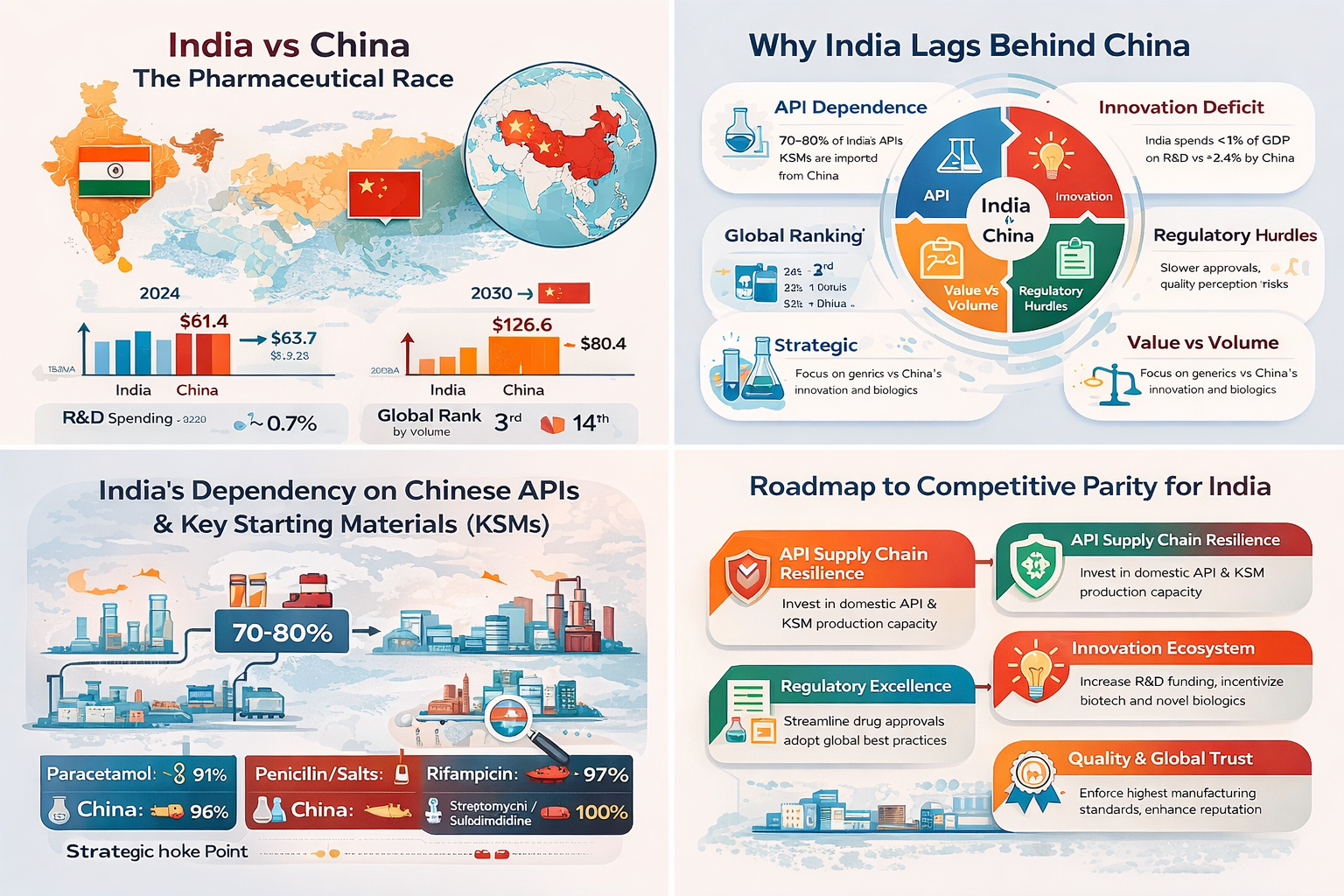
India and China represent two of the most influential forces in global pharmaceuticals. India is globally recognized as the “Pharmacy of the World”, supplying affordable medicines at unmatched scale. China, however, has rapidly repositioned itself as an innovation-led pharmaceutical powerhouse.
Despite India’s manufacturing dominance, China is decisively pulling ahead in value creation, innovation depth, regulatory agility, and strategic control of supply chains. This divergence is not incidental—it is structural, policy-driven, and accelerating.
From RIAR Consulting’s analysis, India’s competitive lag stems from four systemic gaps:
This blog outlines why the gap exists and how India can realistically move toward competitive parity—leveraging regulatory reform, quality intelligence, innovation enablement, and data-driven compliance frameworks.
From RIAR Consulting’s analysis, India’s competitive lag stems from four systemic gaps:
India’s pharmaceutical future cannot rely solely on volume leadership.
The next phase demands innovation, regulatory excellence, supply-chain sovereignty, and data-driven decision-making.
India ranks 3rd globally by pharmaceutical volume, yet only 14th by value.
China, in contrast, is 2nd globally by value, driven by biologics, patented therapies, and high-margin innovation.
While India’s pharmaceutical market is projected to grow at a healthy CAGR (8–11%), China’s growth—though slightly lower in percentage terms—adds far greater absolute value due to its innovation-heavy product mix.
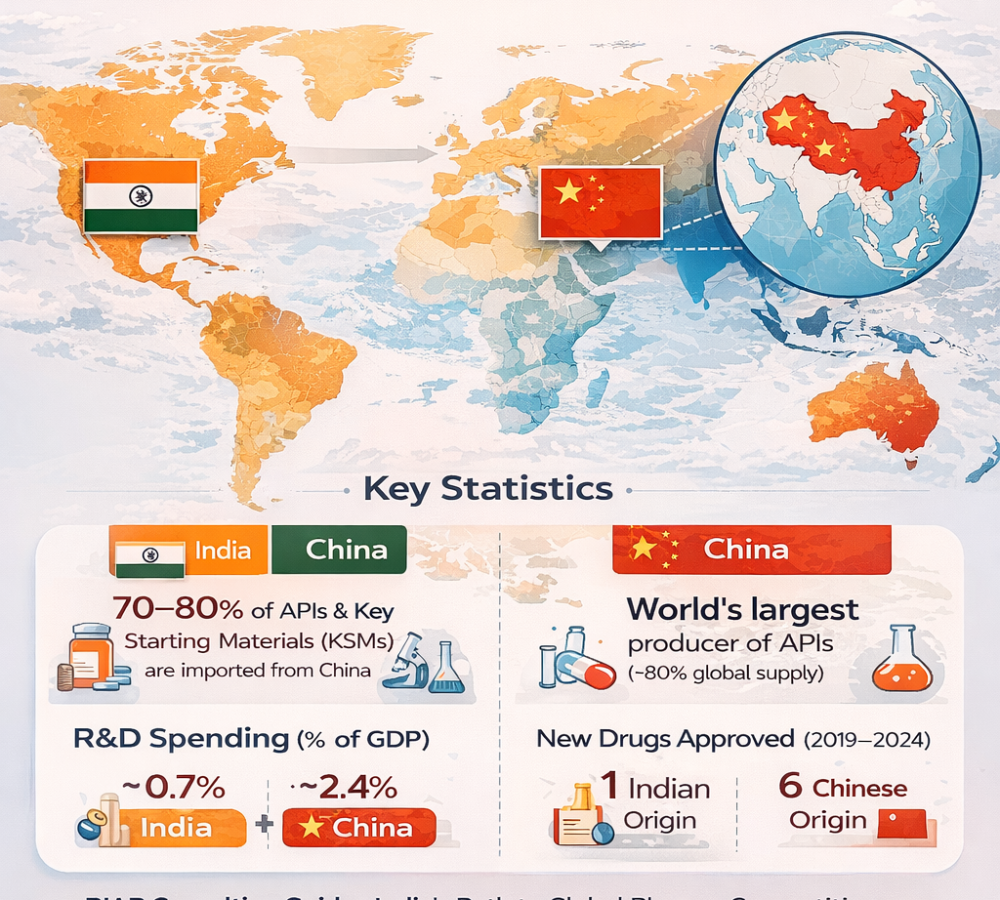
India imports 70–80% of its APIs and KSMs from China, including near-total dependence for critical molecules such as paracetamol, penicillin, ibuprofen, rifampicin, and amoxicillin.
This dependency creates:
Geopolitical vulnerability
Supply chain fragility
Pricing exposure
Regulatory continuity risks
China’s dominance is reinforced through:
Massive economies of scale
Vertical integration with chemical industries
State subsidies and infrastructure support
India’s Production-Linked Incentive (PLI) schemes are a step forward—but remain defensive and corrective, not transformative.
China invests ~2.4% of GDP in R&D.
India invests <1% of GDP.
In absolute terms:
China: ~USD 445 billion
India: ~USD 28 billion
This gap directly translates into outcomes:
6 Chinese-origin innovative drugs approved by US FDA (2019–2024)
1 Indian-origin innovative drug approved in the same period
China’s success is amplified by:
“Made in China 2025” & “Healthy China 2030”
Fast-track regulatory approvals via NMPA
Acceptance of global clinical trial data
Strong IP protection for innovators
Low cost of capital and deep biotech VC funding
India’s innovation ecosystem remains constrained by:
High capital cost
Risk-averse culture
Limited academia–industry translation
Brain drain of scientific talent
Functions as a strategic accelerator
Enables global trial data usage
Offers priority and conditional approvals
Actively attracts global R&D programs
Fragmented central–state processes
Slower approval timelines
Limited innovation-oriented pathways
Reactive rather than enabling posture
Under US FDA inspections, India records a higher proportion of adverse outcomes, often related to cGMP deviations and quality system failures—impacting global confidence.
Indian pharma expansion has largely focused on:
Acquiring overseas generics portfolios
Buying distribution and approvals
Scaling existing business models
Chinese pharma expansion increasingly centers on:
Licensing innovative assets globally
Multi-billion-dollar biotech partnerships
Exporting IP, not just products
This shift signals a fundamental repositioning of China as a global innovation supplier.
Global supply-chain diversification is real. India is well positioned to benefit—but only if it moves up the value chain.
To capitalize, India must demonstrate:
Regulatory predictability
Quality consistency
API resilience
Innovation readiness
Data-driven compliance maturity
Low cost alone is no longer sufficient.
Transition from compliance checking to compliance intelligence
Invest in predictive regulatory analytics
Adopt AI-enabled quality systems
Focus on niche innovation, not broad imitation
Create a unified long-term pharma innovation vision
De-risk early-stage R&D via co-investment models
Modernize CDSCO as a global innovation enabler
Promote regulatory digitalization and transparency
Riar Consulting supports pharmaceutical, medical device, cosmetic, and emerging healthcare companies with structured regulatory strategies, submission management, and market entry support across major global regulatory authorities.
Stay informed with RIAR Consulting as we share key regulatory updates, compliance insights, and global market access guidance.Your trusted partner for efficient approvals across SFDA, US FDA, EU, UK, and India.
Give Us A Call
Drop Us a Line
Office Location
RIAR Consulting Private Limited
Copyright © 2025. All rights reserved.