
From Manufacturing Problems to Medicine Shortages
- Open Hours : Mon-Sat 09:00 - 20:00 Pm IST
riarcompany.2025@gmail.com
January 9, 2026
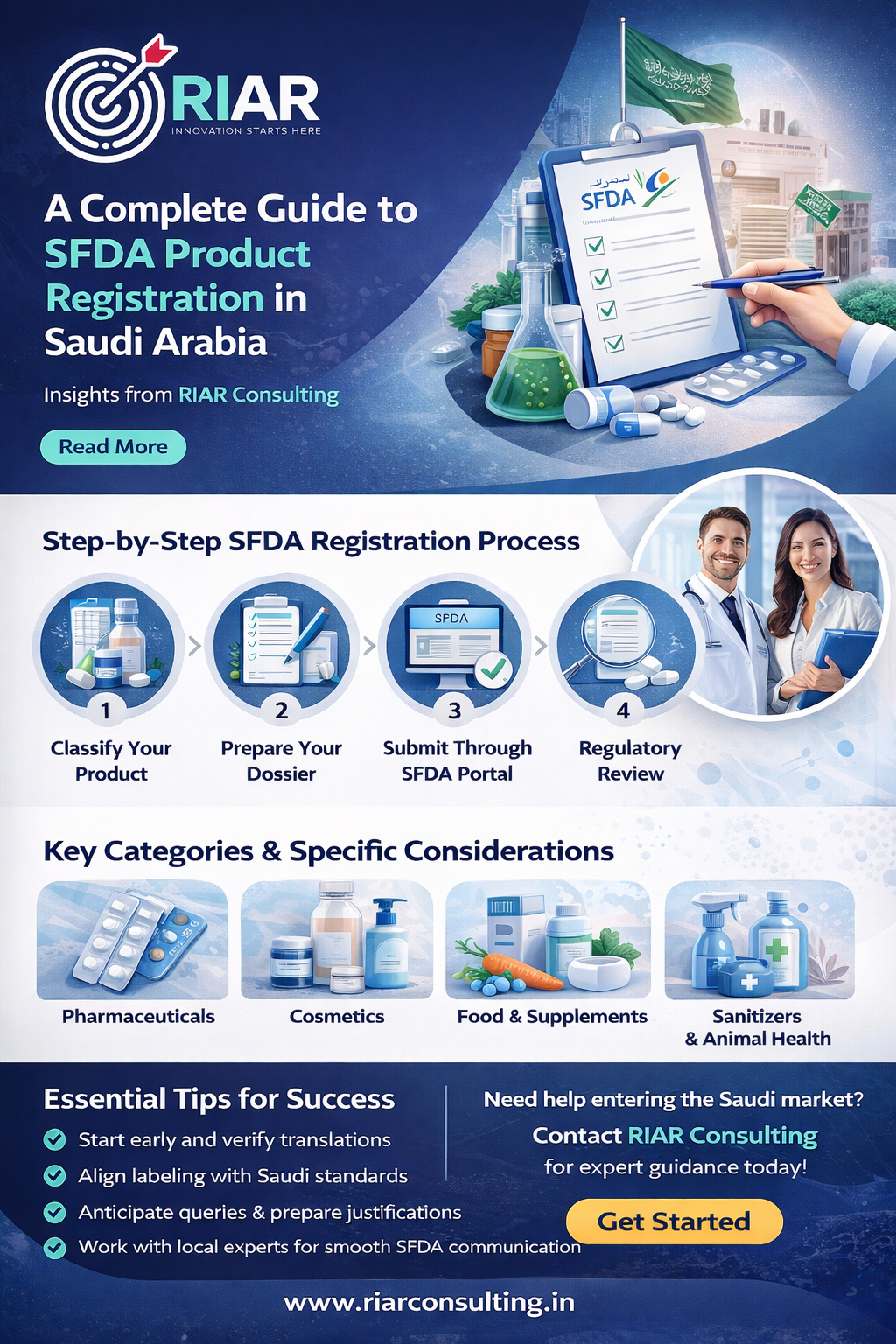
Expanding into the Kingdom of Saudi Arabia (KSA) offers immense opportunities for life science, food, health, and consumer goods companies. However, Saudi Arabia’s regulatory ecosystem is governed by one authority — the Saudi Food and Drug Authority (SFDA). Ensuring your products are compliant with SFDA regulations isn’t just a legal requirement — it’s a cornerstone of successful market access.
At RIAR Consulting, we help global businesses navigate the SFDA landscape efficiently with minimal delays and maximum regulatory compliance. This guide breaks down what you must know about SFDA product registration in Saudi Arabia — including who can apply, key steps, timelines, compliance strategies, and best practices.
The SFDA oversees the approval, quality, and safety of a broad spectrum of products entering the Saudi market — from pharmaceuticals and medical devices to foods, cosmetics, and supplements. Without SFDA registration or notification, your products cannot legally be imported, marketed, or sold within the Kingdom.
Saudi regulators also enforce compliance via customs inspections and post-market surveillance, ensuring consumer safety and authenticity.
Before diving into the process, it’s important to clarify who can submit applications:
Local Saudi entities with valid commercial and SFDA licensing can submit directly.
International companies usually register through:
A local legal entity established in Saudi Arabia.
A scientific office (for pharmaceuticals).
An authorized representative (for certain product classes).
Choosing the right structure depends on your product category, strategy, and long-term business goals in the region.
Every product must be classified under the SFDA’s regulatory categories. Some products (like cosmetics or simple food items) may follow a notification or listing procedure rather than a full review.
Requirements vary by category, but typically include:
Product composition and technical file
Manufacturer licenses and GMP certificates
Safety data (lab tests, clinical studies where applicable)
Labeling and artwork compliant with Saudi requirements (including Arabic translations)
For pharmaceuticals, dossiers may require clinical, stability, and bioequivalence data.
Applications are submitted via the SFDA electronic system, where they are routed to the relevant regulatory review division.
For high-risk products (e.g., drugs, medical devices), detailed scientific evaluation occurs. Reviewers may raise queries or requests for clarification during this phase.
Lower-risk categories like basic foods or cosmetics might be listed without full evaluation, though full compliance is expected upon entry into the Kingdom.
When all criteria are met, the SFDA issues a Marketing Authorization (MA) or listing confirmation, giving companies the legal go-ahead to import and sell their product in the Kingdom.
Pharmaceutical products undergo the most rigorous review. Requirements include GMP certification, laboratory testing, stability studies, and often pricing assessment. The final approval usually results in a five-year registration certificate valid for renewal.
Cosmetics are registered via a notification process. SFDA lists products quickly, but compliance with labeling and formulation standards is enforced mainly at port clearance and in-market inspections. Non-compliant products can be refused at customs or recalled post-market.
Food product registration is generally less stringent but still requires full compliance with Saudi and GCC standards on ingredients, labels, and manufacturers.
These categories follow specific classification rules, and products may be regulated as health products, medical devices, or subject to external standards.
The time required for SFDA registration varies by product type and dossier complexity:
Cosmetics and simple notifications can be processed in days or weeks.
Comprehensive regulatory reviews for pharmaceuticals and high-risk products may take several months.
Fees are category-specific and range from minimal charges for simple product classification to significantly higher fees for drug registrations.
Even after registration, companies have ongoing responsibilities:
Maintain updated product information and labeling.
Report adverse events or changes in formulation.
Renew registration before expiry.
Comply with customs entry checks and inspections.
At RIAR Consulting, we emphasize proactive planning:
✅ Start documentation early and verify all translations.
✅ Anticipate queries and prepare scientific justifications.
✅ Align labeling with Saudi standards before submission.
✅ Work with local specialists for smoother communication with SFDA.
These practices help avoid delays, reduce queries, and minimize compliance risks.
Before diving into the process, it’s important to clarify who can submit applications:
Local Saudi entities with valid commercial and SFDA licensing can submit directly.
International companies usually register through:
A local legal entity established in Saudi Arabia.
A scientific office (for pharmaceuticals).
An authorized representative (for certain product classes).
Choosing the right structure depends on your product category, strategy, and long-term business goals in the region.
Riar Consulting supports pharmaceutical, medical device, cosmetic, and emerging healthcare companies with structured regulatory strategies, submission management, and market entry support across major global regulatory authorities.
Stay informed with RIAR Consulting as we share key regulatory updates, compliance insights, and global market access guidance.Your trusted partner for efficient approvals across SFDA, US FDA, EU, UK, and India.
Give Us A Call
Drop Us a Line
Office Location
RIAR Consulting Private Limited
Copyright © 2025. All rights reserved.
Hello,
I need a consulting service to determine whether my software falls under the SaMD requirements (For export to Saudi Arabia). Please provide guidance.
Thank you.
Hi Elodie,
Thank you for your interest!
Please Contact Over Mail : info@riarconsulting.in