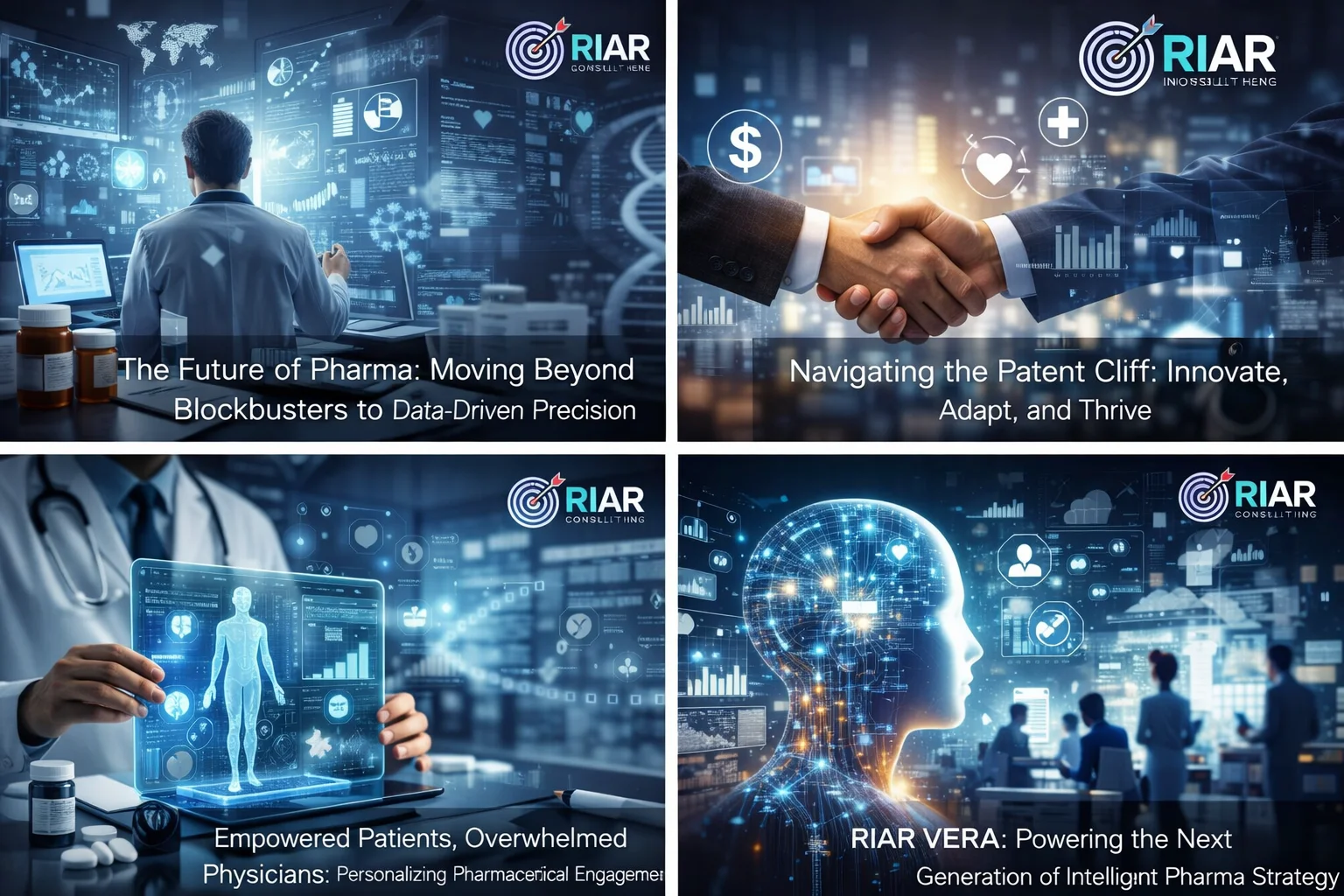
The pharmaceutical industry is entering a decisive decade. Traditional growth engines—blockbuster drugs, extended patent exclusivity, and large field sales forces—are no longer sufficient in a healthcare ecosystem defined by data transparency, patient empowerment, payer scrutiny, and rapid digital innovation.
From 2025 to 2030, pharma leaders will face unprecedented challenges:
- Massive patent expirations
- Pricing and access pressure
- Rising expectations from patients and physicians
- Fragmented data and inefficient commercialization models
At RIAR Consulting, we believe the next era of pharma leadership will be shaped by data-driven intelligence, AI-powered execution, patient-centric design, and value-based outcomes. This blog outlines the new pharma playbook—and how forward-looking organizations can win in this new reality.
Part I: Why the Old Pharma Commercial Model Is Breaking Down
1. The Decline of the Blockbuster-Centric Model
For decades, pharma success relied on:
- Mass-market therapies
- Premium pricing under patent protection
- High-frequency physician detailing
That model is eroding.
Growth is shifting toward specialty and precision therapies—oncology, immunology, rare diseases—where:
- Patient populations are smaller
- Decision-making is complex
- Value must be demonstrated, not assumed
Large sales forces and mass messaging are inefficient in this environment. What’s required instead is precision engagement powered by data.
2. The Patent Cliff: A Structural Shock to the System
Between now and 2030:
- Hundreds of billions of dollars in revenue will lose exclusivity
- Major brands will see 80–90% erosion within a year of generic entry
This makes one thing clear: every year of exclusivity must deliver maximum, measurable value.
The old “spray and pray” commercial model cannot survive this pressure. Pharma must move toward ROI-driven, intelligence-led commercialization.
3. Empowered Patients and Overloaded Physicians
Patients are no longer passive. They expect:
- Transparency
- Digital-first engagement
- Ongoing support beyond the pill
Physicians are overwhelmed with information and have less time than ever. They want:
- Relevant insights
- Delivered at the right moment
- Integrated into clinical workflows
There is now a clear disconnect between how pharma communicates and how stakeholders want to engage. Bridging this gap requires advanced analytics, AI, and personalization at scale.
Part II: The New Fuel & Engine – Data and AI
4. Beyond Clinical Trials: Real-World and Patient-Generated Data
Modern pharma strategy is fueled by:
- Real-World Data (RWD): EHRs, claims, registries
- Patient-Generated Health Data (PGHD): wearables, apps, patient-reported outcomes
These data sources enable:
- Stronger payer value narratives
- Better patient adherence insights
- Real-world effectiveness measurement
Clinical trial data is no longer the finish line—it’s the starting point.
5. AI as the Commercial Intelligence Engine
AI transforms raw data into action.
Key applications include:
- Predictive market and demand forecasting
- Hyper-personalized HCP and patient engagement
- Faster content optimization and compliance reviews
- Smarter allocation of commercial resources
AI allows pharma to shift from reactive execution to proactive strategy.

Click or tap an image to open it full size.
Part III: The New Commercial Blueprints
6. Patient-Centricity as a Growth Strategy
Patient-centricity is now a business necessity, not a marketing theme.
Leading organizations:
- Design services around patient journeys
- Support access, adherence, and education
- Embed patient insights into trials and launches
Operational excellence in patient support directly impacts outcomes, brand trust, and long-term value.
7. Value-Based Contracting: Aligning Price with Performance
Value-based models link reimbursement to real-world outcomes.
They:
- Reduce payer risk
- Reward meaningful innovation
- Improve patient access
While complex, value-based contracting is inevitable in a system demanding proof, not promises.
8. Hyper-Personalization Through Optichannel Engagement
The future is not omnichannel—it’s optichannel.
That means:
- Selecting the optimal channel for each stakeholder
- Delivering context-aware, timely communication
- Measuring impact at the individual level
The focus shifts from frequency of touchpoints to quality of interactions.
Part IV: The Game Changer – How RIAR VERA Powers the New Pharma Playbook
9. Introducing RIAR VERA: The Intelligence Layer for Future-Ready Pharma
While many pharma companies recognize the need for transformation, execution often fails due to:
- Fragmented data systems
- Siloed teams
- Lack of real-time intelligence
- Limited visibility into outcomes
RIAR VERA was designed to solve exactly this problem.
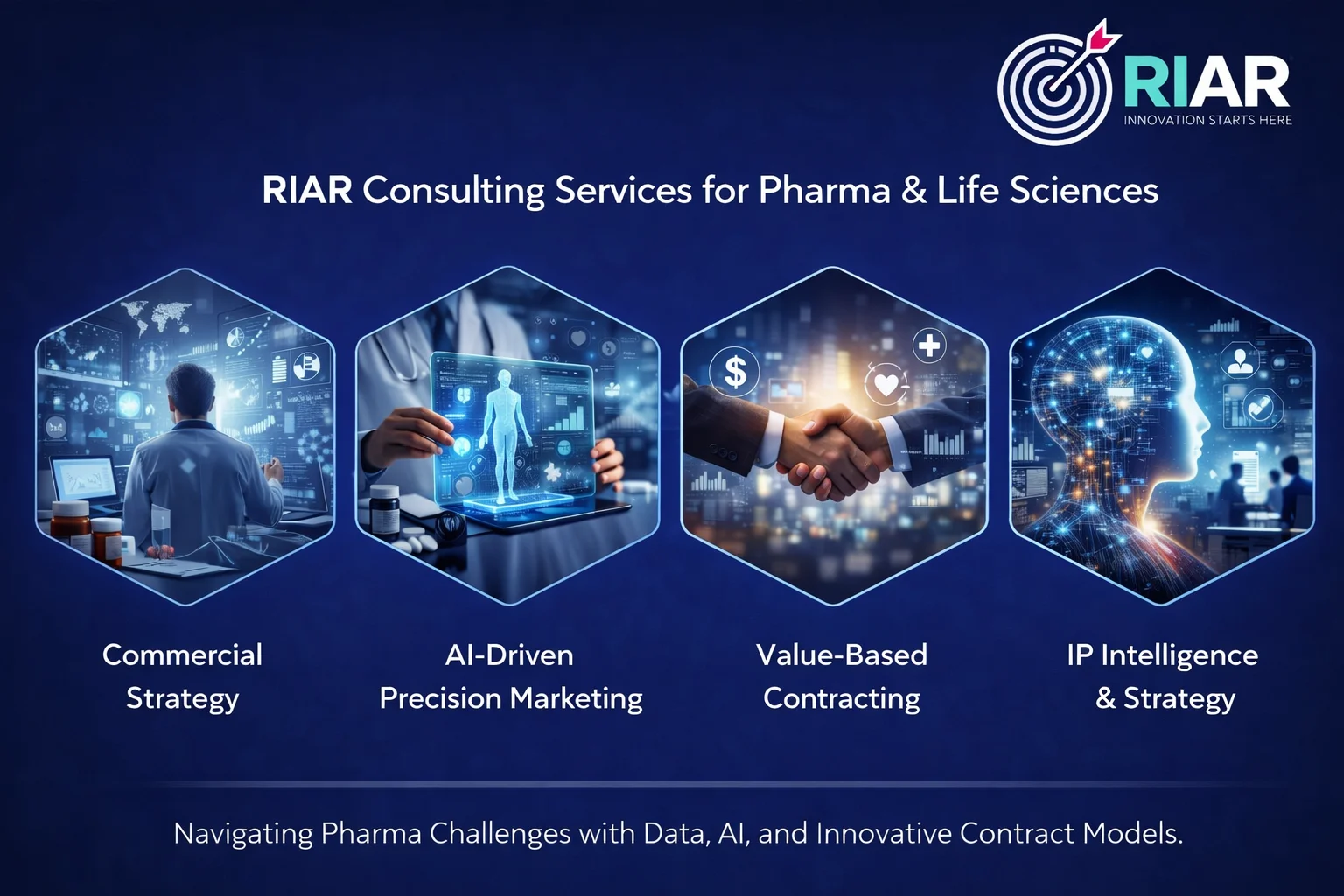
VERA is RIAR Consulting’s AI-powered pharma intelligence and engagement platform, purpose-built to enable the new commercial playbook.
10. Why RIAR VERA Is a Game Changer
RIAR VERA acts as a central nervous system for modern pharma commercialization by unifying data, intelligence, and execution.
1. Unified Data Intelligence
VERA integrates:
- Clinical trial insights
- Real-world and patient-generated data
- Market, payer, and engagement signals
This creates a single source of truth across commercial, medical, and strategy teams.
2. AI-Driven Personalization at Scale
Using advanced analytics and machine learning, VERA enables:
- HCP-level precision targeting
- Patient journey–based engagement
- Optichannel decision-making in real time
Every interaction becomes relevant, contextual, and measurable.
3. Enabling Value-Based Models
VERA helps organizations:
- Track real-world outcomes
- Monitor adherence and utilization
- Generate evidence for payer discussions
This makes value-based contracting operationally viable, not just theoretically attractive.
4. Faster, Smarter Decision-Making
With predictive insights and closed-loop analytics, leaders can:
- Anticipate market shifts
- Optimize launch strategies
- Maximize value during patent-protected years
VERA turns data into foresight, not just hindsight.
11. Strategic Impact of RIAR VERA
With RIAR VERA, pharma companies can:
- Reduce commercial waste
- Increase ROI per interaction
- Strengthen payer and provider trust
- Improve patient outcomes
- Build sustainable competitive advantage
In short, VERA enables pharma to compete on intelligence, not just molecules.
Part V: Looking Ahead to 2030
12. Ethics, Trust, and Responsible AI
As data and AI usage grows, trust becomes the ultimate differentiator.
Future-ready organizations must prioritize:
- Transparent consent models
- Bias-aware AI systems
- Strong data governance and privacy
Ethics is no longer a compliance checkbox—it is a core pillar of brand value.
13. The Pharma Organization of the Future
Winning organizations will:
- Break down internal silos
- Combine in-house strategy with expert partners
- Upskill teams in data, AI, and digital execution
Transformation is not optional—it is existential.
Conclusion: The New Axis of Pharma Market Leadership
The pharmaceutical industry is not just changing—it is being redefined.
Between 2025 and 2030, leaders will be those who:
- Master real-world data
- Embed AI into daily decision-making
- Put patients at the center
- Prove outcomes to payers
- Build trust through ethical innovation
At RIAR Consulting, and through platforms like RIAR VERA, we help pharma organizations move from legacy execution to future-ready intelligence.
The next generation of pharma dominance will not be built on scale alone—it will be built on data, value, personalization, and trust.

What readers think
No ratings yet
No comments yet. Be the first to share your view.