From Manufacturing Problems to Medicine Shortages
riarcompany.2025@gmail.com
September 11, 2026

What the Pharmathen–Paliperidone Case Teaches Us About Manufacturing Intelligence
A medicine shortage is rarely just a supply-chain event.
By the time a shortage becomes visible to the market, the underlying manufacturing risk may have been developing for weeks or months across quality systems, facility controls, equipment, production operations, regulatory activities, and supply planning.
The recent Pharmathen–paliperidone case provides an important real-world lens through which to examine this challenge.
More importantly, it raises a question that is becoming increasingly relevant across complex manufacturing industries:
Can manufacturers identify connected signals of emerging risk before those signals become a major operational or supply disruption?
This is where the concept of continuous manufacturing intelligence becomes particularly important.
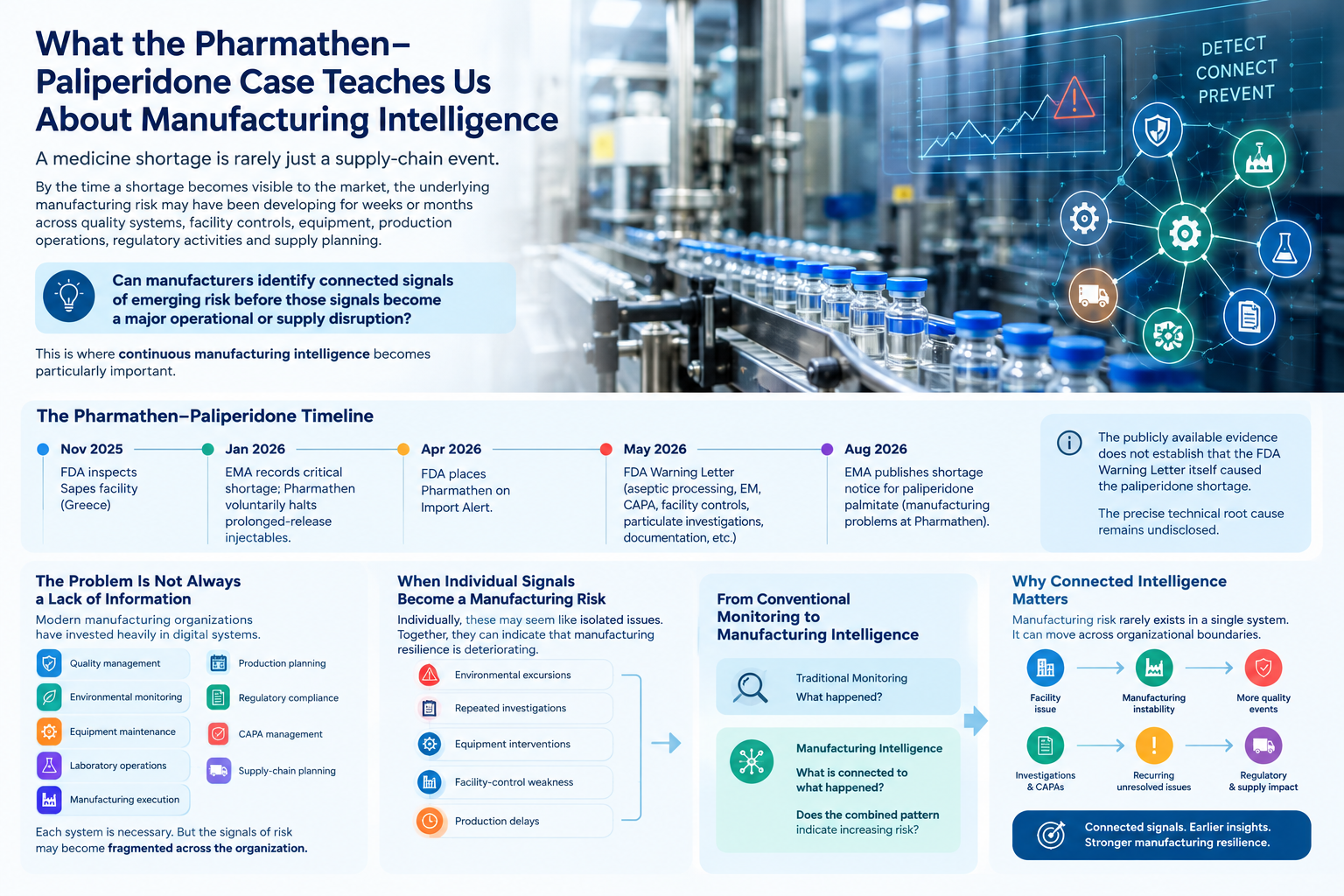
The Pharmathen–Paliperidone Timeline
Publicly available regulatory information shows a sequence of significant events involving Pharmathen International.
In November 2025, the U.S. FDA inspected Pharmathen’s Sapes facility in Greece.
The subsequent FDA Warning Letter, issued in May 2026, identified significant Current Good Manufacturing Practice concerns involving areas including aseptic processing, environmental monitoring, investigations, CAPA, facility controls, visible particulate investigations, documentation, and laboratory controls.
In January 2026, the European Medicines Agency’s Medicine Shortages SPOC Working Party recorded a critical shortage involving paliperidone prolonged-release suspension for injection and noted that Pharmathen International had voluntarily halted manufacturing of prolonged-release injectables.
In April 2026, the FDA placed Pharmathen International on an Import Alert.
In August 2026, the EMA published a shortage notice for paliperidone palmitate medicines in several EU Member States, identifying manufacturing problems at Pharmathen International as the reason for the shortage.
This chronology is significant.
However, one distinction is essential:
The publicly available evidence does not establish that the FDA Warning Letter itself caused the paliperidone shortage.
The precise technical root cause of the shortage has not been publicly disclosed.
Therefore, this case should not be presented as a simple cause-and-effect story.
Instead, it is more valuable as an example of how manufacturing, quality, regulatory and supply events can exist within the same operational environment and potentially create broader continuity risks.
The Problem Is Not Always a Lack of Information
Modern manufacturing organizations have invested heavily in digital systems.
There are systems for:
Quality management
Environmental monitoring
Equipment maintenance
Laboratory operations
Manufacturing execution
Production planning
Regulatory compliance
CAPA management
Supply-chain planning
These systems are necessary.
But they can also create an unexpected challenge:
The signals of risk may become fragmented across the organization.
A quality team may see a recurring deviation.
An engineering team may see repeated equipment interventions.
A facility team may observe environmental or pressure-related issues.
A regulatory team may be managing inspection observations.
Production may be experiencing delays or reduced availability.
Supply-chain teams may see increasing exposure to a particular product or manufacturing site.
Each function may be managing its own information appropriately.
Yet the larger pattern may remain difficult to see.
When Individual Signals Become a Manufacturing Risk
Consider a simplified scenario.
A sterile manufacturing line experiences repeated environmental excursions.
At the same time, similar investigations continue to appear.
An equipment issue requires repeated intervention.
A facility-control weakness remains unresolved.
Production schedules begin experiencing interruptions.
Individually, none of these events necessarily means that a major disruption is imminent.
But together, they may indicate that manufacturing resilience is deteriorating.
This is where the distinction between conventional monitoring and manufacturing intelligence becomes important.
Traditional monitoring asks:
What happened?
Manufacturing intelligence should go one step further:
What is connected to what happened?
And then:
Does the combined pattern indicate increasing risk?
Why Connected Intelligence Matters
Manufacturing risk rarely exists in a single system.
It can move across organizational boundaries.
A facility issue can affect manufacturing.
Manufacturing instability can increase quality events.
Quality events can trigger investigations and CAPAs.
Recurring unresolved issues can increase regulatory exposure.
Reduced manufacturing availability can affect supply.
The challenge is understanding these relationships early enough.
A system that only monitors individual events may identify each issue correctly while still missing the collective signal.
This is the gap that continuous manufacturing intelligence seeks to address.
Introducing VERA
At RIAR Consulting, this challenge led us to develop VERA—a continuous manufacturing intelligence system designed around the idea that manufacturing risk should be understood as a connected environment rather than a collection of isolated events.
VERA is not intended to replace the systems manufacturers already use.
Instead, its purpose is to create an intelligence layer across those systems.
The concept is straightforward:
Connect the signals.
Understand the relationships.
Identify emerging patterns.
Provide context for decisions.
Depending on the manufacturing environment, these signals can include:
Quality
Deviations, investigations, OOS/OOT events, CAPAs, recurring observations and quality trends.
Facility
Environmental monitoring, pressure differentials, temperature, humidity, cleanroom conditions and facility-control signals.
Equipment
Maintenance events, recurring failures, interventions, downtime and equipment performance.
Manufacturing
Batch performance, production interruptions, line availability, process events and capacity constraints.
Regulatory
Inspection findings, commitments, warning letters, regulatory actions and compliance-related events.
Supply
Product availability, manufacturing dependencies, capacity exposure and supply continuity indicators.
The value is not simply collecting these signals.
The value comes from connecting them.
From Dashboard to Intelligence Layer
There is an important difference between displaying information and interpreting connected signals.
Imagine a manufacturing executive receives the following:
A conventional approach may require several teams to manually bring this information together.
A continuous intelligence approach can help surface the relationship between these events.
Instead of presenting five unrelated alerts, the organization could receive a connected view such as:
Manufacturing continuity risk is increasing around a specific manufacturing area due to recurring quality events, equipment interventions and facility-control signals occurring within the same operational period.
The important part is not the wording.
It is the connection between the signals.
What VERA Is Designed to Help Answer
The fundamental questions behind VERA are management questions:
What is changing?
Identify meaningful shifts rather than simply recording individual events.
What is recurring?
Surface patterns that may otherwise remain buried within separate investigations or workflows.
What is connected?
Identify relationships between quality, facility, equipment, manufacturing, regulatory and supply signals.
Where is risk accumulating?
Highlight areas where multiple signals are converging.
What could be affected?
Help organizations understand potential exposure to manufacturing continuity, quality or supply.
Where should management look first?
Prioritize attention based on connected evidence rather than isolated alerts.
The Importance of Explainability
Manufacturing intelligence cannot simply produce a mysterious score.
A statement such as:
“Risk Score: 87”
may attract attention, but it does not necessarily help a quality head, plant head or COO make a decision.
The intelligence needs context.
For example:
Risk is increasing because recurring quality events, equipment interventions and facility-control signals are concentrated around the same manufacturing area.
That gives management something to investigate.
It creates a trail from:
Signal → Relationship → Pattern → Risk → Action
This is particularly important in regulated industries where decisions need to be supported by evidence and human review.
Could Technology Have Predicted the Pharmathen Shortage?
This is an important question—and one that should be answered carefully.
We cannot claim that VERA could have predicted the Pharmathen–paliperidone shortage.
We do not have access to Pharmathen’s internal manufacturing systems, historical operational records, quality records or proprietary supply information.
Nor has the complete technical root cause of the shortage been publicly established.
What this case does demonstrate is something different.
It shows the potential value of connecting manufacturing and regulatory signals across time and functions.
If an organization can continuously identify recurring patterns, understand relationships between events and monitor accumulating risk, it may be able to create earlier visibility into problems that otherwise remain fragmented.
That is a much more defensible and useful proposition.
From Reactive to Proactive Manufacturing Risk Management
Manufacturing organizations traditionally respond to events through established quality and operational processes.
An event occurs.
An investigation begins.
Root cause is assessed.
CAPA is initiated.
Effectiveness is monitored.
This remains essential.
But organizations are increasingly asking a broader question:
Can we see the accumulation of risk before the major event?
This requires a shift from purely reactive event management toward continuous risk visibility.
Instead of asking only:
“What went wrong?”
organizations can begin asking:
“What signals are changing, and what are they collectively telling us?”
Why This Matters Beyond Pharmaceuticals
Although the Pharmathen case is particularly relevant to pharmaceutical manufacturing, the underlying problem is not limited to pharma.
The same principle can apply to other complex manufacturing environments.
Medical devices.
Biologics.
Chemicals.
Automotive.
Electronics.
Advanced materials.
Food and beverage.
Aerospace.
In each of these environments, operational continuity depends on multiple interconnected systems and processes.
The terminology may change.
The regulatory requirements may change.
The manufacturing processes may change.
But the fundamental challenge remains:
Important signals are often distributed across the organization, while risk develops across the organization.
The Role of Regulatory Intelligence
One area that makes this approach particularly relevant to RIAR is the connection between regulatory intelligence and manufacturing intelligence.
Regulatory events should not necessarily be viewed as isolated compliance activities.
A regulatory observation may provide an important signal about an underlying manufacturing vulnerability.
Similarly, recurring operational issues may eventually become relevant to regulatory compliance.
Connecting these perspectives can provide management with a more complete understanding of risk.
This is where regulatory expertise becomes valuable.
Technology can connect and process signals.
But understanding their regulatory significance requires domain knowledge.
The combination of both is what creates a more meaningful intelligence capability.
The Larger Opportunity
The manufacturing industry has spent decades building systems to capture events.
The next opportunity is to build systems that help organizations understand relationships between those events.
The goal is not more alerts.
Manufacturing teams already receive enough alerts.
The goal is better context.
Not:
“An event occurred.”
But:
“This event is recurring.”
Not:
“A deviation was recorded.”
But:
“Similar deviations are appearing around the same process.”
Not:
“A facility issue exists.”
But:
“Facility, quality and production signals are converging around the same manufacturing area.”
That is the difference between information and intelligence.
A New Way to Think About Manufacturing Resilience
The Pharmathen–paliperidone case is ultimately a reminder that manufacturing continuity is not owned by one department.
It sits at the intersection of:
Quality + Operations + Facility + Equipment + Regulatory + Supply
When these functions operate independently, important relationships can remain hidden.
When their signals can be connected continuously, organizations have the opportunity to identify emerging patterns earlier and make more informed decisions.
That is the thinking behind VERA.
Not replacing existing manufacturing systems.
Not promising perfect prediction.
Not turning every operational event into a crisis.
But creating a continuous intelligence layer that helps organizations understand what is happening, what is connected, where risk may be accumulating, and what deserves attention.
The Question We Should Be Asking
The most important lesson from this case is not simply that manufacturing problems can lead to shortages.
It is that the visible disruption may occur much later than the underlying risk begins to develop.
The opportunity for modern manufacturing technology is therefore not only to explain what happened after the event.
It is to provide organizations with better visibility while the situation is still evolving.
Because the earlier a manufacturer can see a connected pattern, the more opportunity there may be to investigate, intervene and protect continuity.
From isolated signals to connected intelligence.
That is the direction manufacturing intelligence is moving toward—and it is the problem VERA is being built to address.
Important Note
This article is an analytical discussion based on publicly available regulatory information concerning Pharmathen International and paliperidone palmitate.
It does not establish a direct causal relationship between the FDA Warning Letter and the paliperidone shortage, and it does not claim that VERA could have predicted the specific shortage.
The Pharmathen case is used as a real-world reference point to illustrate the broader challenge of fragmented manufacturing signals and the potential role of continuous manufacturing intelligence.
Have Any Question?
Riar Consulting supports pharmaceutical, medical device, cosmetic, and emerging healthcare companies with structured regulatory strategies, submission management, and market entry support across major global regulatory authorities.
- (+91)99 274 94539
- info@riarconsulting.in